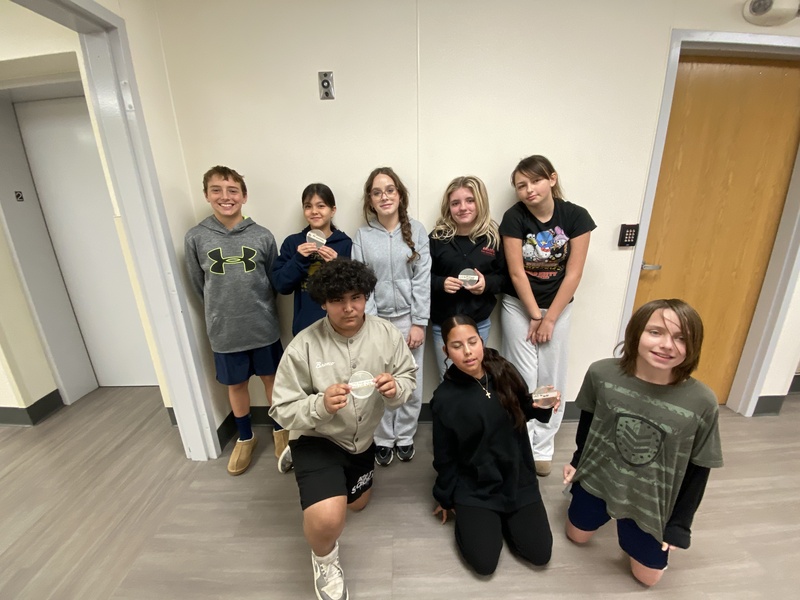
What’s hiding on the surfaces we touch every day? Valley Park Middle School sixth graders are putting their scientific skills to the test as they investigate the microscopic world of bacteria found throughout campus.
In Mrs. Jaclyn Vogel’s sixth-grade science classes, students recently became scientists themselves, traveling around campus to collect bacteria samples from commonly touched surfaces. From bathroom surfaces and door handles to cafeteria hand sanitizer dispensers, students selected locations they believed might be home to the most bacteria.
Before collecting their samples, students developed hypotheses about which surfaces would produce the most bacterial growth. They then learned how to properly collect samples, set up an experiment and document their findings. Over the coming days, students will monitor bacterial growth and record observations on their science websites.
For sixth grader Garret Turner, the boys' bathroom seemed like a logical place to investigate.
"I collected a bacteria sample from the sixth-grade boys' bathroom. I chose this location because I thought it would have a lot of bacteria because students use the bathroom every day," he explained.
However, Garrett also predicts another location might have the most bacteria.
"I think that the gym floor would have the most bacteria out of all of the surfaces we collected bacteria from," he said. "You don't know where people's shoes have been. Middle school and high school students use the gym."
Josie Lembeck and her team took their investigation to the elementary school, where they sampled an interior front door handle because of how frequently it is touched throughout the day. Josie predicts the elementary boys' bathroom could have the most bacterial growth, noting that younger students may not always wash their hands thoroughly.
Meanwhile, Camden Miravalle chose a surface that might surprise some people: the hand sanitizer dispenser in the elementary cafeteria.
"If you are using the hand sanitizer, your hands are probably dirty, so I thought there would be a lot of bacteria on the handle," he explained.
Camden predicts the dispenser will produce the most bacterial growth because so many people use it throughout the day.
The hands-on investigation connects directly to the sixth-grade science curriculum, which explores unicellular and multicellular organisms and how cells function to stay alive.
"This experiment gives students the opportunity to take what they've learned in the classroom and apply it to the world around them," said sixth-grade science teacher Jaclyn Vogel. "They're not just learning about bacteria and how living organisms function. They're asking questions, making predictions, collecting evidence and thinking like scientists. I'm excited for them to see their results and discover whether their hypotheses were correct."
Beyond learning about bacteria, students are practicing essential scientific skills, including developing hypotheses, designing experiments, collecting data and making observations.
The experiment also encourages students to think critically about their everyday surroundings and the importance of hygiene.
As students continue monitoring their samples, they'll have an opportunity to compare their predictions with their actual findings. Will the gym floor, bathroom surfaces or hand sanitizer dispenser reveal the most bacterial growth? Only time and a little science will tell!
Click on the photos below to see our sixth-grade scientists in action!