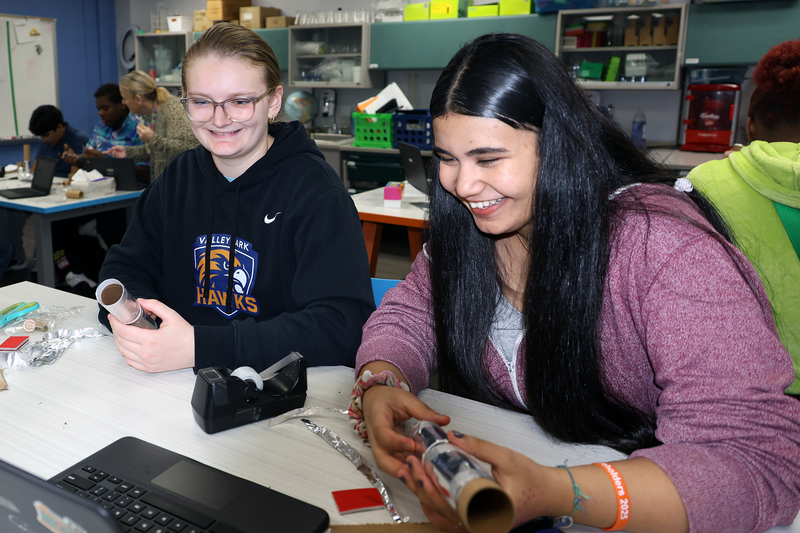
In Dr. Sindel’s eighth grade science class, this application-based radio receiver project served as the final piece of students’ learning about the electromagnetic spectrum, with a strong focus on transverse and longitudinal waves. While many students could confidently explain how waves work, applying that knowledge in a real-world setting added a new layer of challenge and growth..
As students worked to build their radio receivers, the process quickly became one of trial and error. Some receivers worked, many didn’t, and only a handful of students were able to hear static through their devices. But the true learning went far beyond the final result. This experience reflected a key focus of engaging students in learning that is active, authentic and rooted in problem-solving rather than memorization.
Throughout the project, students practiced critical thinking and perseverance. When designs didn’t work as expected, students had to analyze what went wrong, make adjustments and try again. They also learned that science, much like life, doesn’t always cooperate on the first attempt.
Just as important were the conversations that happened along the way. Students talked openly about frustration and learned strategies for managing it, including knowing when to step away and come back with a fresh perspective. One student shared that the project really tested his patience, but that he felt it was a good thing. These moments supported social and emotional learning, helping students build resilience and self-awareness alongside academic skills.
This project also highlighted the importance of effective instruction and meaningful assessment. Success wasn’t measured only by whether the receiver worked, but by how students engaged in the process, reflected on their learning and grew through the experience. By valuing the learning journey as much as the outcome, students were encouraged to take risks and persist through challenges.
A special thank you to BASF for providing the grant funding that made this learning experience possible. Their support helped bring interactive science to life and gave students the opportunity to explore complex concepts while building skills they’ll use far beyond the classroom.
In the end, the radio receiver project reinforced science content while also building character. Students grew in their understanding of waves, but they also gained patience, perseverance and confidence in tackling complex problems. Experiences like this prepare students not just for tests, but for real-world challenges they’ll face long after they leave the classroom.
Take a look at the project in action. Click the photo below to view the full gallery.