What does it take to keep a boat afloat? For Valley Park seventh graders, the answer involved a little science, some engineering and plenty of problem-solving.
In Innovators and Makers, a Project Lead The Way course, students recently put their understanding of density and buoyancy to the test with a hands-on design challenge.
After learning how density affects whether an object will float or sink, students worked in teams and were given the same limited amount of materials to design and build their own boats. But before construction began, they had to think like engineers.
Each team first sketched its design and considered how the shape and structure of the boat could affect its ability to float. Students then calculated the density of their completed boats and used the mass of a penny to estimate how many pennies they believed their design could hold before sinking.
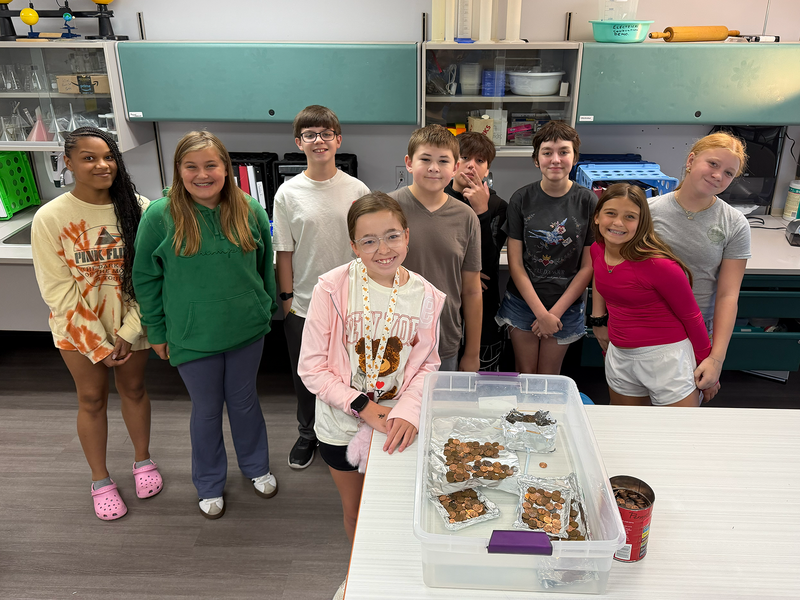
Then came the moment of truth: testing their hypotheses. One by one, pennies were added as students watched to see whether their calculations and designs would hold up. The challenge brought classroom concepts to life while giving students an opportunity to collaborate, problem-solve, make predictions and learn through testing and observation.
Two teams rose to the top of the challenge. Ethan McGlawn and Bowen Milne designed a boat that held 62 pennies, while Madison Schneider and Journey Gilmore created a design that supported an impressive 121 pennies before sinking.
The learning went well beyond density and buoyancy. Throughout the challenge, students practiced skills that help prepare them for future learning, careers and life.
Students used critical thinking and problem-solving to determine how their designs could support additional weight, collaboration and communication as they worked through ideas with teammates, and application of academic knowledge as they used math and science concepts to make real-world predictions. The design-and-test process also encouraged creativity, perseverance and reflection, especially when the results didn't quite match the original hypothesis.
Most importantly, students weren't simply learning a concept and repeating it back. They were asked to apply what they knew, make decisions, test their thinking and use the results as evidence.
That's Limitless Learning in action: connecting academic knowledge with the skills students need to solve problems, work with others and take their learning beyond the classroom.
Take a closer look at their learning! Click the photo below.